Tiny Cowboys, Big Lessons: The Courage to Hold On, The Courage to Let Go.
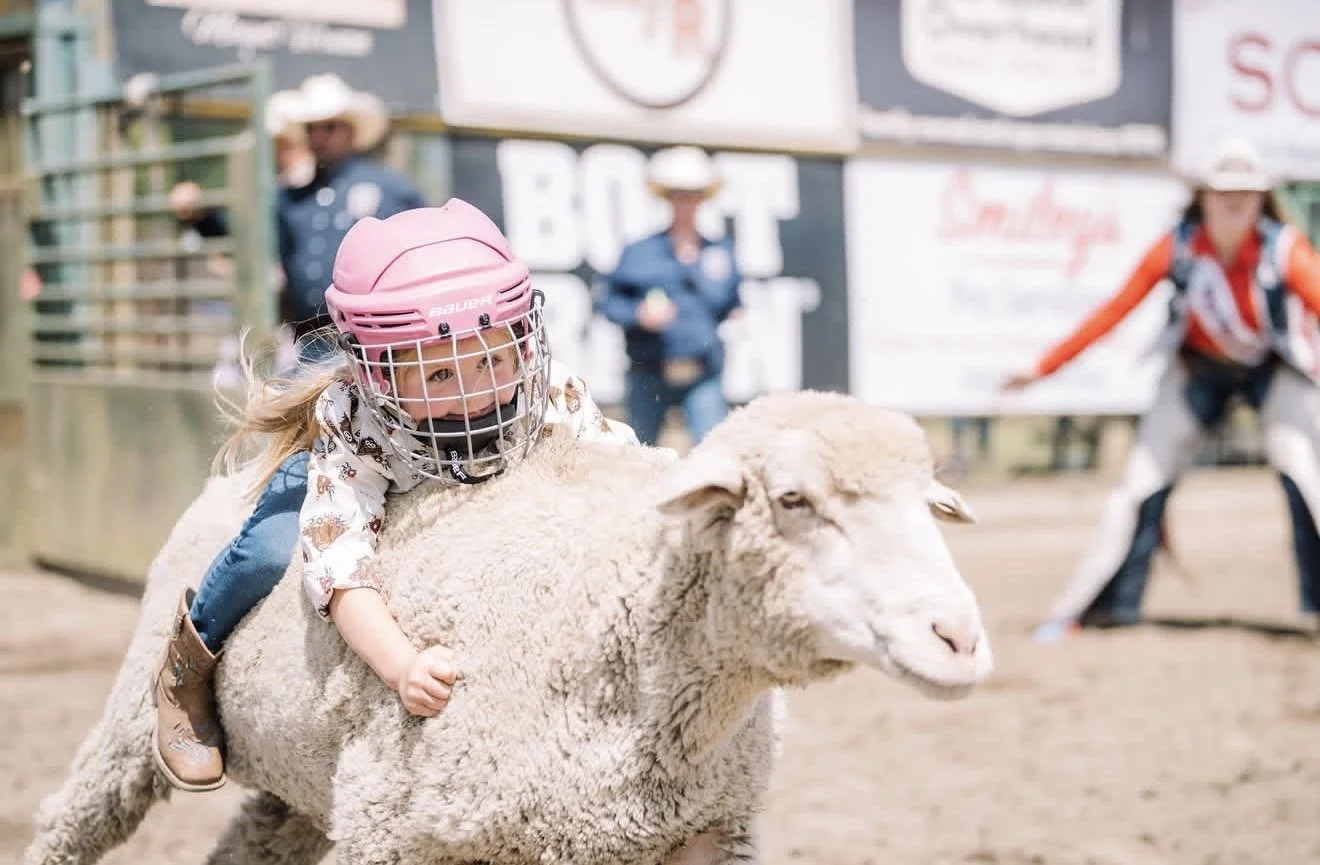
Image courtesy of Instagram handle: @SWCRodeo
Apparently, every girl has a little cowgirl hiding somewhere. Mine finally came out at the Santa Barbara Rodeo. Maybe it started years ago with the cowboy boots I have always loved, or perhaps it was when I gifted myself a beautiful cowboy hat for my birthday.
Whatever it was, this was my very first rodeo, and I was as excited as any first-timer could be.
The moment I walked through the gates, I understood why families have been coming to these events for generations. The smell of dirt, the music, the cheering crowd, and the sight of cowboys on horseback with dust rising into the evening sky all created something deeply nostalgic, even though I had never experienced it before. I expected to see bulls, horses, and plenty of dust. What I did not expect was to become completely captivated by a group of tiny children riding sheep.
Once again, children reminded me that they are often more capable than we imagine. Having spent more than twenty-five years observing infants and toddlers, I have watched babies discover their own abilities. This happens not because adults rush in to teach them every step, but because they are given the time, freedom, and trust to explore. I have watched babies learn to roll, crawl, stand, climb, and walk, witnessing the incredible determination children have when we allow them to discover what their own bodies can do. I thought I had a pretty good understanding of what children were capable of until I went to my very first rodeo. As I found my spot near the arena fence, I looked out at the dirt and realized the main event for me wasn't going to involve adult cowboys at all.
What surprised me most was not only the competition itself, but the families. Little children were everywhere, parents were cheering, and generations were sharing an experience together. If you have never seen mutton busting before, imagine children no older than five, six, or seven years old wearing tiny helmets and protective vests, holding onto a sheep as it races across the arena.
I found myself standing near the gate, unable to look away from the tiny cowboy boots, small helmets, and faces mixed with nervousness and excitement. Then the gate opened. The sheep bolted out, and the little riders held on with everything they had, their legs wrapped around the animal and their arms gripping tightly, completely determined to stay on. Some children lasted only a few seconds before tumbling into the dirt, while others held on much longer than I ever imagined possible. Every time a child fell, an adult was immediately there. A hand reached out, a parent ran forward, and the child was picked up, dusted off, and comforted.
One little rider especially caught my attention. He stayed on longer than the others, so much longer that his sheep continued racing across the arena, carrying him farther and farther away. That was when I saw his mother begin running after them, chasing the sheep as it carried her little cowboy across the dirt. In that moment, you could feel two kinds of courage happening at the exact same time: the courage of a little child holding on for dear life, and the courage of a mother letting go for just a few seconds. Then, the instant her child lost his grip and fell, instinct took over. She sprinted across the arena, scooped him up, and squeezed him close, hugging him so tightly that I could almost feel the relief in her embrace.
She held him close before carrying him back toward the fence.
What stayed with me was not the fall, but his face. He was smiling and looked proud, like a child who had just accomplished something genuinely difficult. That moment made me pause because I realized I was witnessing something that felt both surprising and deeply familiar.
I have spent my career helping parents understand that children are capable. Through the work of Magda Gerber and the RIE approach, we learn the importance of observing children, trusting their abilities, and allowing them to experience their own competence. Children often borrow our emotional cues. When we remain calm during age-appropriate challenges, they learn confidence. When we communicate trust in their abilities, they begin to discover trust in themselves.
Of course, this does not mean we remove our responsibility to protect them. The children at the rodeo had helmets, protective gear, and adults nearby. The goal was not to eliminate every possibility of falling, but to create an environment where children could try something challenging while knowing they were supported. This is the beautiful balance we strive for, balancing freedom and safety, exploration and protection, independence and connection.
Magda Gerber reminded us that children learn through their own experiences. She wrote that learning to fall, getting up again, and moving on is the best preparation for life. She also asked what a fall is, noting that it is simply losing your balance. What a profound lesson for childhood and for life.
Children will fall. They will stumble and face challenges we cannot always remove for them. Our role is not to prevent every difficult moment, but to be present, attentive, and supportive as they discover their own strength. Even after twenty-five years of trusting children's abilities, I realized there was still more they could teach me. Maybe that is one of the greatest gifts children give us. We think we are the ones helping them discover what they are capable of, but sometimes they are helping us discover it too.
As I walked back to my car that evening, cowboy hat in hand, I found myself thinking less about the sheep and more about the children. I thought about their determination, their confidence, and their smiles after they hit the dirt. My first rodeo did not change my philosophy, it deepened it. Once again, children reminded me that they are often more capable than we imagine. And perhaps, that evening, the mothers reminded me of something just as important: trusting a child isn't the opposite of protecting them. Sometimes, trusting them is one of the greatest forms of protection we can offer.
As parents, teachers, and caregivers, we face our own arena fences every single day. We watch the children in our care step up to challenges whether it is a toddler climbing a slightly too-high structure at the park, or a preschooler insisting on pouring their own milk. In those split seconds, do we have the courage to let go for just a moment? Can we trust that our presence at the fence is enough?
Wondering how this looks in your own family?
If you're navigating the balance between protecting your child and giving them the freedom to discover what they can do, I'd love to help.
Through parent consultations, infant and toddler guidance, and personalized support for families and caregivers, I help adults better understand children's capabilities and learn when to step in, when to step back, and how to stay connected along the way.
If this is something you're thinking about in your own family, reach out to me directly. I'd be happy to connect.